

- Market Size (2026)
- USD 3.5 Bn
- Forecast (2036)
- USD 9.4 Bn
- CAGR (2026 to 2036)
- 11.6%
Smart Locks Market Size, Market Forecast and Outlook By FMI
FMI report reflects that the smart locks market value stood at USD 3.1 billion in 2025. Industry revenue is anticipated to cross USD 3.5 billion in 2026 and reach USD 9.4 billion by 2036 at 11.6% CAGR. By end-use application, residential is projected to account for 71.0% share in 2026. By distribution channel, direct sales are expected to hold 58.0% share in 2026.
Summary of the Smart Locks Market
- Demand and Growth Drivers
- Residential access demand is expanding as homeowners replace mechanical keys with keypad and phone-based entry.
- Builders are adding connected locks to premium homes with residential smart locks becoming easier to pair with smart speakers.
- Property managers use time-limited codes to reduce key handover work across rental and short-stay units.
- Product and Segment View
- Residential is projected to account for 71.0% share in 2026 due to homeowners remaining the main buyer group for front-door access upgrades.
- Direct sales are expected to hold 58.0% share in 2026 since lock brands work with builders and property owners directly.
- Bluetooth-enabled locks are projected to represent 49.0% share in 2026 as phone-based entry supports simple setup and lower power use.
- Geography and Competitive Outlook
- United States is projected to record 11.2% CAGR by 2036 due to DIY retrofit depth and builder channel activity.
- China and India are expected to advance at 13.8% CAGR by 2036 as mobile access and new housing demand advance together.
- ASSA ABLOY and Fortune Brands Innovations compete through brand reach. Allegion, Samsung Electronics and dormakaba add access control depth.
- Analyst Opinion
- Nikhil Kaitwade, Principal Analyst for Automotive at FMI, observes, "Our team is observing smart locks manufacturers focusing away from a device-only sale toward a trusted access layer for homes. Buyers first check whether the lock works reliably with their phones and platforms before considering finish options. Suppliers controlling software security and hardware reliability will defend margins better than basic keypad brands. Residential channels will remain central while rental and hospitality use cases add steady volume by 2036."
- Smart Locks Market Value Analysis
- Smart locks are shifting from basic keyless entry into connected access-control systems for homes and rental properties.
- Lock manufacturers are expected to raise use of app-based authentication as buyers seek simple entry control without extra hardware.
- Bluetooth-enabled locks are gaining preference since home users need easy phone pairing and lower battery drain.
- Demand is supported by residential replacement cycles in which a front-door lock upgrade can add security and smart home value.
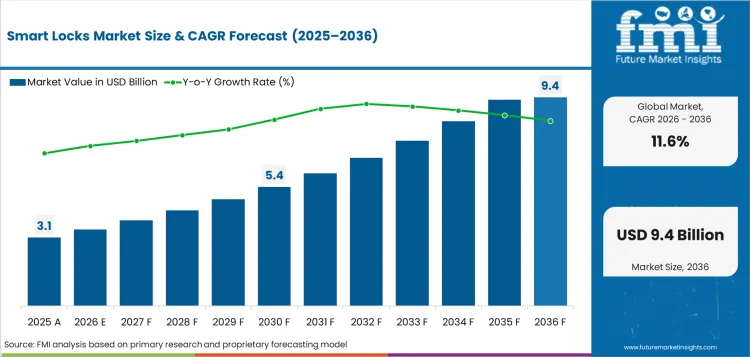
Key Takeaways, Market Size, and Forecast
| Metric | Value |
|---|---|
| Market Size (2025) | USD 3.1 Billion |
| Market Size (2036) | USD 9.4 Billion |
| CAGR (2026–2036) | 11.6% |
| Market Size (2026) | USD 5.9 Billion |
| Leading Application (2026) | Residential |
| Residential Share (2026) | 71.0% |
| Leading Distribution Channel (2026) | Direct Sales |
| Direct Sales Share (2026) | 58.0% |
| Fastest-Growing Country | China |
| China CAGR | 13.8% |
Security proof is becoming the first buyer question because smart locks now comes between home entry and cloud-managed access. UK rules in force since 29 April 2024 require connected-product suppliers to address default passwords, security reporting and update-period disclosure. That turns compliance files into a retail and importer requirement. Vulnerability records add the operational reason. NVD’s March 2024 record for Chirp Access identified hard-coded BEACON_PASSWORD and Bluetooth beacon setting exposure. Property managers are likely to question app credential controls before rollouts. Product design is shifting at the same time. Aqara’s U300 combines Matter-over-Thread, Apple home key, IPX4 protection and up to 10 months of battery life. Such features move smart locks into side doors and garages. Yale and August’s Airbnb integration shows the service layer, with reservation-timed door codes making access management part of hosting workflow.
Smart Locks Market Definition
Smart locks are electronic door locking systems allowing authorized entry through phone apps and keypads. Scope covers deadbolts and lever locks sold with embedded access electronics. Revenue covers hardware and bundled access functions used in homes and managed properties.
Smart Locks Market Inclusions
Market scope covers all commercially traded smart lock products categorized by lock type, including deadbolts and lever handles. Authentication scope includes Bluetooth-enabled locks and Wi-Fi-enabled locks across smartphone access and keypad access formats. Communication scope covers Bluetooth and Wi-Fi protocols with Z-Wave and Zigbee systems included. End use scope covers residential and commercial properties with institutional and hospitality settings included. Technology scope includes conventional smart locks and advanced smart locks across standalone and integrated systems. Revenue scope covers 2026 to 2036 for factory-installed systems and replacement purchases across direct and indirect channels. Main stakeholders include smart lock manufacturers and access-control hardware suppliers. Stakeholder scope also includes chipset providers and smart home platform companies. Property developers and commercial building owners form the main buyer groups. Retailers and installation partners support the route to consumers across replacement and new construction channels.
Smart Locks Market Exclusions
Scope excludes mechanical-only locks and generic door handles. Wired enterprise-only access controllers and software-only access apps sit outside the revenue boundary.
Smart Locks Market Research Methodology
- Primary Research: FMI analysts reviewed residential lock brands, smart home installers and property security buyers. Interviews focused on entry reliability, battery replacement and return risk.
- Desk Research: Desk review used housing activity and broadband readiness. IoT security rules and official company launches from 2024 onward shaped the evidence file.
- Market Sizing and Forecasting: Forecast work combined home completion volumes and replacement cycles. Country adoption was adjusted using mobile access use and builder channel maturity.
- Data Validation: Segment shares were checked against front-door replacement patterns, radio protocol fit and channel buying routes. Competitive positions were cross-checked against active product portfolios.
Why is the Smart Locks Market Growing?
- Homeowners need phone-based entry as family access and delivery access become routine daily use cases.
- Builders specify smart locks as smart home packages move into new residential projects.
- Property managers prefer temporary codes due to rental turnover and service access making physical key control costly.
Residential entry is becoming a managed access point instead of a simple lock replacement. United States Census Bureau and USA Department of Housing and Urban Development data from February 2026 stated that 1.5 million privately owned housing units were completed in 2025. New completions give builders and homeowners a clear moment to install residential smart lock systems before occupants move in. Front-door readiness supports faster conversion since smart locks are easier to sell during renovation and move-in decisions. Installation timing supports factory and builder-led sales instead of only later retail replacement.
Interoperability is lowering a common barrier for buyers who do not want separate apps for every device. Connectivity Standards Alliance released Matter 1.4 in November 2024 to improve multi-admin setup and home network reliability. Wider standard support makes locks easier to connect with smart home devices already used by buyers. Brand selection now favors suppliers able to pass platform certification and keep firmware secure. Platform compatibility favors established access control brands and connected home partners over basic keypad suppliers.
Market Segmentation Analysis
- Deadbolts are projected to represent 39.0% share in 2026 due to front-door replacement staying the first smart lock purchase.
- Bluetooth-enabled locks are expected to account for 49.0% share in 2026 since local phone pairing lowers power use.
- Bluetooth protocol is projected to hold 40.0% share in 2026, led by short-range unlocking integrating in homes and apartments.
- Residential is anticipated to capture 71.0% share in 2026, driven by single-family homes and apartments forming the main buyers.
- Conventional smart locks are expected to represent 48.0% share in 2026 as basic connected functions fit mass-retail price points.
- Direct sales are projected to secure 58.0% share in 2026 as builders and security installers buy through specified project channels.
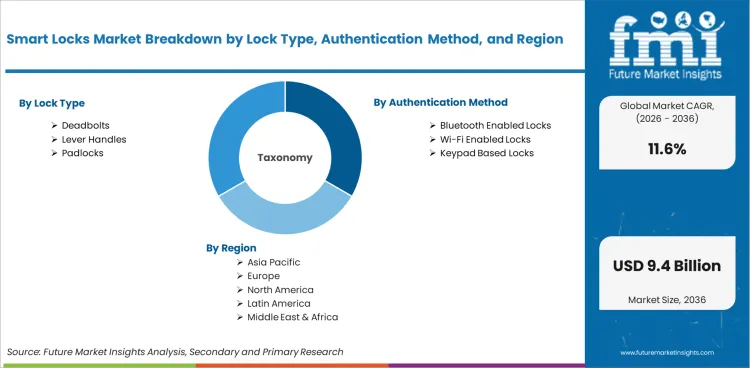
The market is segmented by lock type and authentication method. Communication protocol, end use application and technology complete the product scope. Distribution channel completes the route-to-market view. Lock type segmentation includes deadbolts, lever handles and padlocks. Mortise locks complete the hardware view. Authentication method covers Bluetooth-enabled locks and Wi-Fi-enabled locks. Keypad based locks and biometric locks complete the access view. Communication protocol includes Bluetooth, Wi-Fi and Z-Wave. Zigbee and other protocols complete the connectivity scope.
End-use application covers residential and commercial buyers. Institutional and hospitality users complete the buyer scope. Technology includes conventional smart locks and advanced smart locks. Smart and AI-enabled locks complete the technology view. Distribution channel includes direct sales and indirect sales. Buyers often start with door type and access method. Buyers then check connectivity and service support.
Insights into Smart Locks Market by Lock Type
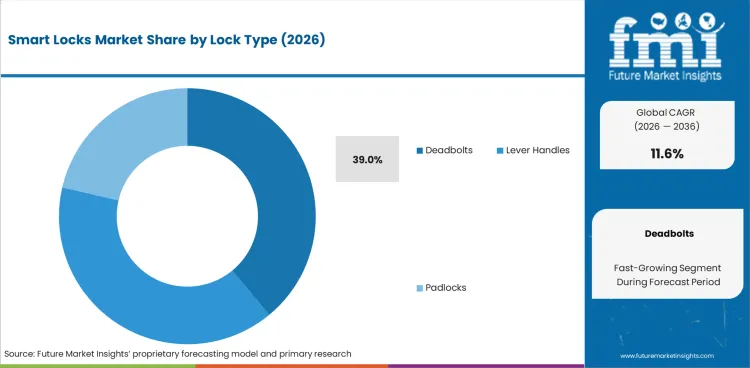
- Deadbolts are expected to account for 39.0% share in 2026 as front doors remain the clearest replacement point for homeowners moving from mechanical keys to app or keypad access.
- Builder and retrofit demand favors deadbolts since installation matches common door preparation without broad changes to interior handle hardware.
Insights into Smart Locks Market by Authentication Method

- Bluetooth-enabled locks are projected to hold 49.0% share in 2026 due to low energy use and simple phone pairing for everyday residential access.
- Bluetooth reduces setup friction for households requiring local unlocking first and remote access later through a hub or connected home bridge.
Insights into Smart Locks Market by Communication Protocol
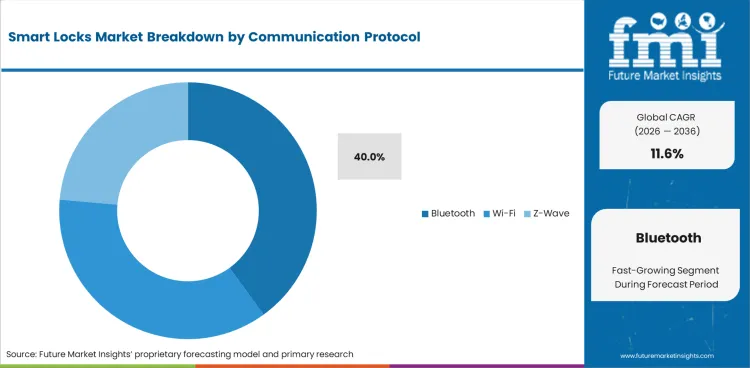
- Bluetooth is expected to account for 40.0% share in 2026 as short-range control fits front doors with limited battery capacity and frequent daily use.
- Wi-Fi locks gain attention for direct remote access, while Bluetooth remains practical for rental and residential units valuing longer battery life.
Insights into Smart Locks Market by End Use Application

- Residential is anticipated to hold 71.0% share in 2026 since single-family homes and apartments create the broadest volume for connected entry upgrades.
- Apartment and condominium demand supports the segment as property managers need audit trails and timed codes without replacing full building access systems.
Insights into Smart Locks Market by Technology
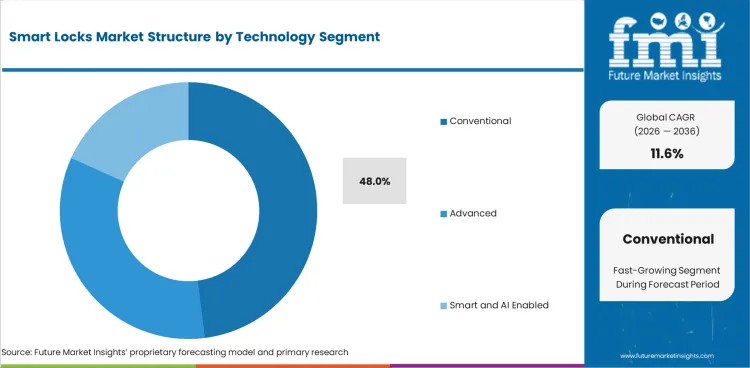
- Conventional smart locks are projected to represent 48.0% share in 2026, driven by basic app and keypad functions meeting most household needs.
- AI-enabled locks should expand from a smaller starting point as behavior alerts and access pattern checks become useful for managed properties.
Insights into Smart Locks Market by Distribution Channel
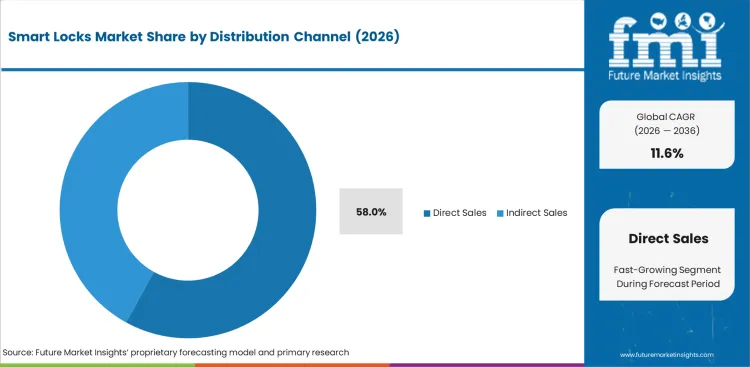
- Direct sales are expected to hold 58.0% share in 2026, led by builders and real estate developers buying connected locks during project specification.
- Indirect sales remain important through home improvement stores and e-commerce, and project orders provide better volume visibility for manufacturers.
Smart Locks Market Drivers, Restraints, and Opportunities
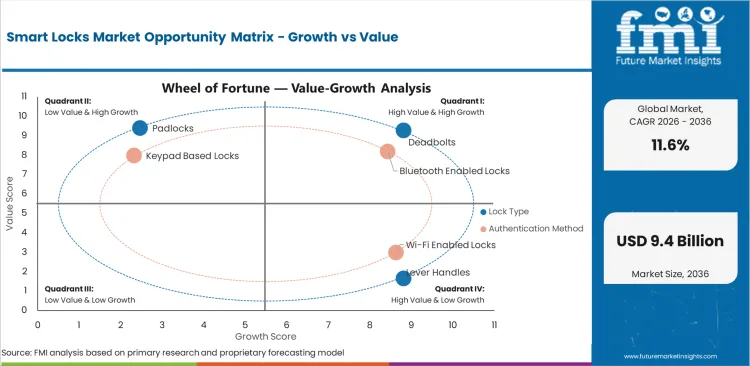
- Smartphone access is expanding the daily use case beyond keys and physical cards.
- Battery failure and cybersecurity risks can slow replacement among cautious homeowners.
- Builder packages create a direct route for access control features in new residential projects.
Mobile access is expected to remain the main driver for smart locks as phones become the control point for home entry. Samsung Electronics announced Digital Home Key in March 2026 for compatible smart door locks using near-field communication and ultra-wideband access. Aliro and Matter are expected to reduce brand lock-in as buyers connect smart home devices across shared platforms. Federal Communications Commission adopted rules in March 2024 for a voluntary cybersecurity label covering wireless consumer Internet of Things products. Battery failure and software security will remain the main adoption barriers for cautious homeowners. Builder packages create a clearer growth route as access control features can be specified before move-in. Suppliers can improve conversion if locks combine fallback entry, clear battery alerts and certified connected performance.
After-sales Service and Lifecycle Cost Analysis
Smart lock after-sales value is expected to move beyond basic warranty support toward full lifecycle control across battery upkeep and end-of-support planning. National Institute of Standards and Technology noted in May 2025 that connected product guidance is expanding toward maintenance, end-of-support and post-market communication. This guidance makes lifecycle cost a sharper buying factor for apartments and managed housing users. Annual service contracts can gain more weight where lock downtime can delay room access or service visits. Suppliers with clear battery guidance and responsive spare-part support can hold stronger account retention over the forecast period.
Regulatory Compliance and Operating Standards Analysis
Smart lock compliance is expected to shift from general product safety toward visible cybersecurity proof as connected entry devices become part of home and property access systems. Federal Communications Commission stated in January 2026 that the USA Cyber Trust Mark framework covers consumer wireless Internet of Things products, and the agency had conditionally approved 11 cybersecurity label administrators. The cybersecurity label raises the standard for suppliers selling app-connected locks through retail and property channels. Certification readiness will matter more as buyers compare firmware support and device data protection. Strong primary evidence after-2024 was not found for a smart-lock-specific energy efficiency rule, so cybersecurity labeling is the more credible compliance driver here.
Regional Analysis
.webp "Top Country Growth Comparison Smart Locks Market Cagr (2026 2036)")
| Country | CAGR 2026 to 2036 |
|---|---|
| United States | 11.2% |
| Germany | 10.5% |
| United Kingdom | 10.1% |
| China | 13.8% |
| Japan | 9.7% |
| Brazil | 11.6% |
| India | 12.9% |
Source: Future Market Insights analysis, 2026.
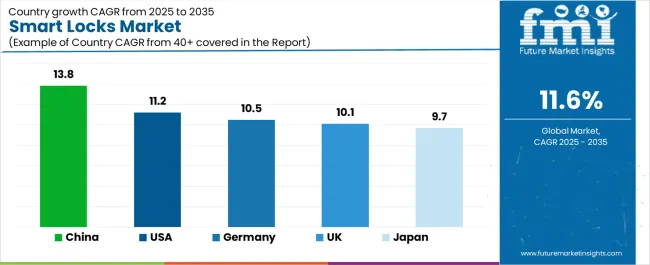
Analysis of Smart Locks Market by Key Countries
- United States is projected to record 11.2% CAGR by 2036, driven by DIY retail and builder packages sustaining connected deadbolt uptake.
- China is expected to expand at 13.8% CAGR by 2036 due to mobile-first access and local lock manufacturing rising adoption.
- India is forecast to grow at 12.9% CAGR by 2036, led by broadband reach and urban housing programs raising connected home readiness.
- Germany is expected to advance at 10.5% CAGR by 2036 since apartment renovation and privacy-focused security buying shape selection.
- United Kingdom is projected to rise at 10.1% CAGR by 2036 as rental management and smart home retail support connected entry.
- Brazil is forecast at 11.6% CAGR by 2036, as construction cost pressure favors retrofit-ready locks over full access system replacement. Japan is expected to post 9.7% CAGR by 2036 as reliability expectations and compact residential formats favor easy-to-install devices.
Country performance differs by housing activity, platform readiness and consumer trust in connected entry. China and India grow faster than the global pace as mobile control and new residential units create wider buying moments. United States and Brazil track close to the global rate through retail replacement and rental use. Germany, United Kingdom and Japan remain attractive through security discipline and higher reliability expectations.
Demand Outlook for Smart Locks Market in the United States
Demand in the United States is projected to record an 11.2% CAGR by 2036, led by builder packages and front-door replacement. United States Census Bureau and United States Department of Housing and Urban Development data released in February 2026 stated that 1.5 million privately owned housing units were completed in 2025. New completions give builders a clear point to specify connected deadbolts before occupants move in. Move-in timing supports replacement of mechanical locks with keypad and phone-based entry. Brands with simple setup and battery backup can improve conversion across retail and builder channels.
- Builder packages support factory-specified locks as smart home devices move into new residential projects.
- Homeowners prefer app access and keypad backup for family entry and service visits.
- Security installers can gain replacement demand as connected deadbolts fit common front-door hardware preparation.
Demand Analysis of Smart Locks Market in Germany
Demand for smart locks in Germany is expected to expand at 10.5% CAGR by 2036, as apartment projects and renovation activity keeps home hardware replacement active. German Federal Statistical Office data listed 238,063 dwellings approved in 2025 after three years of decline. Permit recovery gives lock suppliers a clearer route into multi-family projects and new single-family homes. Smart lock demand is likely to favor products with durable cylinders and secure phone credentials. European buyers are likely to judge connected entry by mechanical reliability before app features.
- Multi-family housing developers need access products balancing tenant turnover with secure daily entry.
- Renovation channels support lock upgrades as door hardware replacement aligns with home improvement work.
- Established access brands gain preference as buyers connect smart locks with tested mechanical security.
Future Outlook for Smart Locks Market in the United Kingdom
The smart locks industry in the United Kingdom is expected to advance at 10.1% CAGR by 2036 due to new housing completions and rental management requiring connected-entry support. Government housing supply data from March 2026 reported that England recorded 41,570 new build dwelling completions in 2025 Q4. New completions and energy performance certificate lodging keep a channel open for connected door hardware in newly occupied homes. Property managers are likely to favor temporary access codes as rental turnover raises the cost of physical key handling. Retail demand is likely to stay active through home improvement channels and online lock sales.
- Rental housing operators need timed codes reducing key handover work during tenant changes.
- Builders can add connected locks as part of standard smart home packages for new homes.
- Retrofit buyers are expected to favor deadbolts with simple installation and clear battery alerts.
Sales Analysis of Smart Locks Market in China
Sales in China are projected to rise at 13.8% CAGR by 2036 as apartment scale and mobile-first access habits influence faster adoption. National Bureau of Statistics of China data released in January 2026 reported that 428.30 million square meters of residential buildings were completed in 2025. Large completed floor space gives smart lock makers a wide apartment door pool even with weaker property sales. Local smart home brands and phone-based payments make connected entry easier for urban buyers. Suppliers with affordable Bluetooth and keypad models can gain faster volume traction.
- Apartment operators need low-cost connected locks simplifying resident turnover and service access.
- Local smart home ecosystems support phone-based entry across new and upgraded residential units.
- Manufacturers with scale production can serve price-sensitive buyers without removing core security features.
Demand Outlook for Smart Locks Market in Japan
The smart locks sector in Japan is forecast at 9.7% CAGR by 2036 due to mature housing replacement and security upgrades sustaining steady premium adoption. Japan housing start data for March 2026 showed 63,495 units started during the month. Lower new-build volume keeps growth below China and India but replacement demand remains useful for premium lock brands. Buyers are likely to favor products with long battery life and precise mechanical fit. Suppliers with reliable after-sales support can gain account strength in managed housing and hospitality properties.
- Replacement demand supports compact smart locks installed in existing residential doors without heavy modification.
- Premium buyers value reliable cylinders and quiet operation over feature-heavy access products.
- Hospitality and managed apartments need access logs managing guest entry and service control.
Opportunity Analysis of Smart Locks Market in Brazil
Industry in Brazil is projected to record an 11.6% CAGR by 2036 as affordable housing activity and developer sales support smart entry adoption. Brazil’s Casa Civil stated in March 2026 that Minha Casa Minha Vida accounted for 52% of real estate launches. Program activity gives connected lock suppliers a route into new housing packages and developer-backed sales. Price-sensitive buyers are likely to favor keypad models with phone access over costly biometric systems. Local distributors are likely to gain by pairing simple lock hardware with installer training.
- Affordable housing developers need low-cost smart locks improving security without raising unit prices sharply.
- Retail channels grow through keypad deadbolts suited to urban apartments and small homes.
- Installers gain business by offering basic phone access with clear manual override options.
In-depth Analysis of Smart Locks Market in India
Demand in India is expected to expand at 12.9% CAGR by 2036, driven by urban housing delivery and mobile access habits attracting more buyers. Press Information Bureau data from January 2026 showed about 9.60 million urban homes had been completed or delivered under Pradhan Mantri Awas Yojana Urban. That scale creates a large housing foundation for digital door hardware as urban buyers move toward app control. Builder and retail channels can gain as connected locks become part of apartment upgrade packages. Suppliers with affordable deadbolts and local service support can benefit most.
- Apartment buyers need secure entry upgrades compatible with common doors and do not require complex wiring.
- Builders can bundle smart locks with connected switches and home automation starter packages.
- Local service networks matter as buyers need battery support and quick replacement guidance.
Competitive Landscape and Strategic Positioning
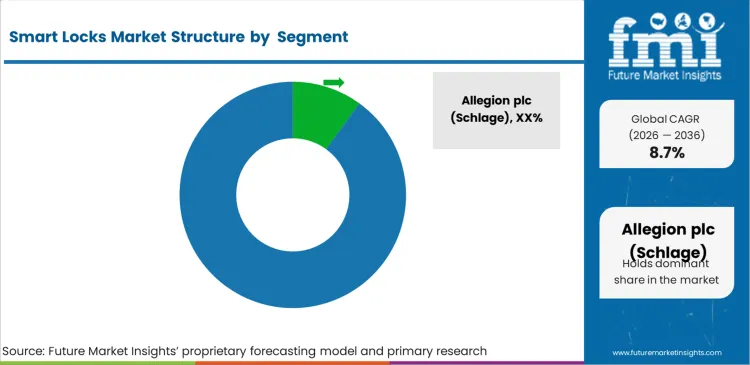
- Competition centers on established access brands able to combine mechanical lock depth with secure app and credential controls.
- Fortune Brands Innovations and ASSA ABLOY shape residential reach through Yale and Kwikset smart access lines.
- Allegion and Samsung target platform fit, while Nuki and Aqara gain attention through retrofit simplicity and Matter-ready features.
The market is led by brands able to pair trusted hardware with secure software support across the lock lifecycle. Fortune Brands controls Yale and August residential smart locks in the United States and Canada. ASSA ABLOY retains broad global access depth and uses product updates to support connected entry. Buyers compare warranty strength and app updates over multiple home ownership cycles before choosing a lock brand.
Platform fit now carries almost the same weight as mechanical durability in connected residential access. Schlage introduced Sense Pro and Arrive smart deadbolts in 2025 with Matter and hands-free entry options. Samsung launched Digital Home Key in March 2026 using Aliro for compatible smart locks. Launch activity connects home access with consumer wallets and connected home systems. Suppliers able to prove safe credentials and simple setup can win stronger builder confidence.
Specialist brands compete by solving clear installation and compatibility problems faster than broader-line suppliers. Nuki launched Smart Lock Ultra in November 2024 and expanded fifth-generation retrofit options in March 2025. Aqara released U300 in October 2024 with Matter-over-Thread and Apple Home Key support. Entry barriers remain high as battery safety and firmware support raise service cost after the first sale. Competitive strength is likely to favor suppliers with durable hardware, secure credentials and reliable software support over feature-only brands.
Key Companies in the Smart Locks Market
Competition spans global lock groups, platform firms and retrofit specialists with active connected entry portfolios.
- Global Lock Groups: ASSA ABLOY AB and Allegion plc compete through mechanical lock brands and dealer networks. ASSA ABLOY carries Kwikset and global Yale assets outside specific divested regions. Allegion uses Schlage to reach DIY buyers and builder channels.
- Connected Home Brands: Fortune Brands Innovations and Samsung Electronics compete through household connected-home access. Fortune Brands controls Yale and August residential locks in the United States and Canada. Samsung uses Wallet and SmartThings to make phone-based entry familiar to Galaxy users.
- Specialist and Commercial Players: dormakaba and Nuki compete through hospitality locks and retrofit hardware. Aqara and U-tec add protocol-ready designs. Buyers use these firms when compact installation or Matter support outweighs broad brand reach.
Competitive Benchmarking: Smart Locks Market
| Company | Access Credential Depth | Smart Home Protocol Fit | Residential Channel Reach | Geographic Footprint |
|---|---|---|---|---|
| ASSA ABLOY AB | High | Strong | High | Global |
| Fortune Brands Innovations | High | Strong | High | United States and Canada |
| Allegion plc | High | High | High | North America and global |
| Samsung Electronics | Strong | High | Medium | Global |
| dormakaba Holding AG | High | Medium | Moderate | Europe and global |
| Aqara | Medium | High | Moderate | China and global |
| Nuki Home Solutions | Medium | High | Moderate | Europe and United States |
| U-tec Group | Medium | High | Moderate | North America and Asia |
Source: Future Market Insights competitive analysis, 2026. Ratings reflect relative position based on credential control, protocol readiness and channel access.
Key Developments in Smart Locks Market
- In January 2025, Schlage introduced Sense Pro Smart Deadbolt and Arrive Smart WiFi Deadbolt.
- In April 2025, Yale and ADT debuted a smart lock with Z-Wave 800 Series support.
- In March 2026, Samsung launched Digital Home Key for smart door locks through Samsung Wallet.
Key Players in the Smart Locks Market
Global Lock and Access Groups
- ASSA ABLOY AB
- Fortune Brands Innovations
- Allegion plc
- dormakaba Holding AG
- Honeywell International Inc.
Consumer Smart Home and Electronics Brands
- Samsung Electronics
- Aqara
- U-tec Group
- Nuki Home Solutions
Channel and Technology Participants
- Yale Home
- August Home
- Schlage
- Kwikset
- UniKey Technologies Inc.
Report Scope and Coverage
| Parameter | Details |
|---|---|
| Quantitative Units | USD 3.5 billion in 2026 to USD 9.4 billion in 2036 at 11.6% CAGR |
| Market Definition | Electronic door locking systems allowing authorized entry through phone apps and keypads. Biometrics and cards enter scope when embedded in lock hardware. |
| By Lock Type | Deadbolts, Lever Handles, Padlocks, Mortise Locks |
| By Authentication Method | Bluetooth Enabled Locks, Wi-Fi Enabled Locks, Keypad Based Locks, Biometric Locks |
| By Communication Protocol | Bluetooth, Wi-Fi, Z-Wave, Zigbee, Other Protocols |
| By End Use Application | Residential, Commercial, Institutional, Hospitality, Other Applications |
| By Technology | Conventional Smart Locks, Advanced Smart Locks, Smart and AI Enabled Locks |
| By Distribution Channel | Direct Sales, Indirect Sales |
| Regions Covered | North America, Latin America, Europe, East Asia, South Asia and Pacific, Middle East and Africa |
| Countries Covered | United States, Germany, United Kingdom, China, Japan, Brazil, India and 30+ countries |
| Key Companies Profiled | ASSA ABLOY AB, Fortune Brands Innovations, Allegion plc, Samsung Electronics, dormakaba Holding AG, Honeywell International Inc., U-tec Group |
| Forecast Period | 2026 to 2036 |
| Approach | Hybrid bottom-up and top-down methodology using housing activity, replacement cycles, channel mix and platform readiness |
Source: Future Market Insights, 2026.
Smart Locks Market Breakdown by Lock Type, Authentication Method, Communication Protocol, End Use Application, Technology, Distribution Channel, and Region
Smart Locks Market Segmented by Lock Type
- Deadbolts
- Lever Handles
- Padlocks
- Mortise Locks
Smart Locks Market Segmented by Authentication Method
- Bluetooth Enabled Locks
- Wi-Fi Enabled Locks
- Keypad Based Locks
- Biometric Locks
Smart Locks Market Segmented by Communication Protocol
- Bluetooth
- Wi-Fi
- Z-Wave
- Zigbee
- Other Protocols
Smart Locks Market Segmented by End Use Application
- Residential
- Commercial
- Institutional
- Hospitality
- Other Applications
Smart Locks Market Segmented by Technology
- Conventional Smart Locks
- Advanced Smart Locks
- Smart and AI Enabled Locks
Smart Locks Market Segmented by Distribution Channel
- Direct Sales
- Indirect Sales
Smart Locks Market by Region
- North America
- United States
- Canada
- Mexico
- Latin America
- Brazil
- Chile
- Rest of Latin America
- Western Europe
- Germany
- United Kingdom
- Italy
- Spain
- France
- Nordic
- BENELUX
- Rest of Western Europe
- Eastern Europe
- Russia
- Poland
- Hungary
- Balkan and Baltic
- Rest of Eastern Europe
- East Asia
- China
- Japan
- South Korea
- South Asia and Pacific
- India
- ASEAN
- Australia and New Zealand
- Rest of South Asia and Pacific
- Middle East and Africa
- Kingdom of Saudi Arabia
- Other GCC Countries
- Turkiye
- South Africa
- Other African Union
- Rest of Middle East and Africa
Research Sources and Bibliography
- Megas, K. N., Fagan, M., Cuthill, B., Hoehn, B., & Petrella, E. (2025). Workshop summary report for “Workshop on foundational cybersecurity activities for IoT device manufacturers” (NIST IR 8562). National Institute of Standards and Technology.
- Federal Communications Commission. (2026, January 26). Public Safety and Homeland Security Bureau announces 20-business day filing window for Cybersecurity Label Administrator applications under the USA Cyber Trust Mark Program and reiterates program obligations (DA 26-75).
- Federal Communications Commission. (2024, March 14). FCC adopts rules for IoT cybersecurity labeling program.
- Connectivity Standards Alliance. (2025, August 11). Matter 1.4.2: Enhancing security and scalability for smart homes.
- USA Census Bureau, & USA Department of Housing and Urban Development. (2026, February 18). New residential construction: December 2025.
- Statistisches Bundesamt. (2026, February 18). Building permits for building construction in Germany.
- Ministry of Housing, Communities and Local Government. (2026, March 19). Housing supply: indicators of new supply, England, October to December 2025.
- National Bureau of Statistics of China. (2026, January 20). Investment in real estate development for 2025.
- Press Information Bureau. (2026, January 29). India is far more urban in economic and functional terms than its administrative boundaries.
- Ministry of Cities, Brazil. (2026, May 3). Minha Casa, Minha Vida is highlighted at a construction sector event.
- Samsung Electronics. (2026, March 2). Samsung Wallet launches Digital Home Key for smart door locks.
- Schlage. (2025, January 6). Schlage introduces the Schlage Sense Pro Smart Deadbolt and Schlage Arrive Smart WiFi Deadbolt.
- Nuki Home Solutions. (2025, March 11). Nuki turns the latest smart lock technology fully retrofittable. Aqara. (2024, October 3).
- Aqara Smart Lock U300 extends intelligence to doors throughout the home.
Reader reference bibliography uses primary government sources and official company publications.
This Report Answers
- What is the forecast value of the smart locks market by 2036?
- What CAGR is expected for the smart locks market from 2026 to 2036?
- Which lock type is projected to account for a strong 2026 share?
- Which authentication method is expected to hold a strong position in 2026?
- Why does residential use account for a strong share of smart lock demand?
- How do Matter, Aliro and cybersecurity labels affect supplier selection?
- Which countries are projected to grow faster than the global pace by 2036?
- Which companies shape smart lock competition across residential and connected access channels?
- Which methodology supports the forecast and segment share assumptions?
Frequently Asked Questions
How big is the global smart locks market in 2026?
The smart locks market is expected to reach USD 3.5 billion in 2026 across residential and selected commercial access applications.
What is the forecast value of the smart locks market by 2036?
The smart locks industry is projected to scale to USD 9.4 billion by 2036 as connected entry moves into homes and managed properties.
What CAGR is projected for the smart locks market from 2026 to 2036?
The sector is expected to expand at 11.6% CAGR from 2026 to 2036 across hardware and connected access channels.
Which lock type is projected to lead the smart locks market in 2026?
Deadbolts are projected to account for 39.0% share in 2026 since front-door replacement is the clearest connected entry use case.
Which end use application holds a strong smart locks market share?
Residential applications are expected to hold 71.0% share in 2026 as homes and apartments create broad connected entry volume.
Which country grows fastest in the smart locks market forecast?
China is projected at 13.8% CAGR by 2036, led by mobile access and new housing demand rising together.
What does the smart locks market include?
The smart locks market includes electronic deadbolts and lever locks with app or keypad access. Padlocks and mortise locks enter scope when sold with connected functions.
How was the smart locks market forecast prepared?
FMI used housing activity and replacement cycles to test the 2026 to 2036 forecast. Protocol adoption and product launches adjusted the outlook.
Are smart locks better than mechanical locks for homes?
Smart locks are better for shared access and remote checks, while mechanical locks remain simpler for buyers who do not need digital control.
How much do smart lock buyers usually compare before purchase?
Most buyers compare installation fit and battery life before price. App support and backup access matter since lock failure creates immediate access risk.
How does a smart lock work in daily use?
A smart lock unlocks through a keypad or phone. A biometric reader or card can verify the user before the motor moves the bolt.
Who uses smart locks beyond homeowners?
Rental managers and hotels use smart locks to issue temporary access. Office owners and service teams reduce physical key handover through the same tools.
Preview the report firsthand - request a free sample
Get SampleGet the brochure for pricing and purchase details.
Get PDFTable of Content
- Executive Summary
- Global Market Outlook
- Demand-side Trends
- Supply-side Trends
- Technology Roadmap Analysis
- Analysis and Recommendations
- Market Overview
- Market Coverage / Taxonomy
- Market Definition / Scope / Limitations
- Research Methodology
- Chapter Orientation
- Analytical Lens and Working Hypotheses
- Market Structure, Signals, and Trend Drivers
- Benchmarking and Cross-market Comparability
- Market Sizing, Forecasting, and Opportunity Mapping
- Research Design and Evidence Framework
- Desk Research Programme (Secondary Evidence)
- Company Annual and Sustainability Reports
- Peer-reviewed Journals and Academic Literature
- Corporate Websites, Product Literature, and Technical Notes
- Earnings Decks and Investor Briefings
- Statutory Filings and Regulatory Disclosures
- Technical White Papers and Standards Notes
- Trade Journals, Industry Magazines, and Analyst Briefs
- Conference Proceedings, Webinars, and Seminar Materials
- Government Statistics Portals and Public Data Releases
- Press Releases and Reputable Media Coverage
- Specialist Newsletters and Curated Briefings
- Sector Databases and Reference Repositories
- FMI Internal Proprietary Databases and Historical Market Datasets
- Subscription Datasets and Paid Sources
- Social Channels, Communities, and Digital Listening Inputs
- Additional Desk Sources
- Expert Input and Fieldwork (Primary Evidence)
- Primary Modes
- Qualitative Interviews and Expert Elicitation
- Quantitative Surveys and Structured Data Capture
- Blended Approach
- Why Primary Evidence is Used
- Field Techniques
- Interviews
- Surveys
- Focus Groups
- Observational and In-context Research
- Social and Community Interactions
- Stakeholder Universe Engaged
- C-suite Leaders
- Board Members
- Presidents and Vice Presidents
- R&D and Innovation Heads
- Technical Specialists
- Domain Subject-matter Experts
- Scientists
- Physicians and Other Healthcare Professionals
- Governance, Ethics, and Data Stewardship
- Research Ethics
- Data Integrity and Handling
- Primary Modes
- Tooling, Models, and Reference Databases
- Desk Research Programme (Secondary Evidence)
- Data Engineering and Model Build
- Data Acquisition and Ingestion
- Cleaning, Normalisation, and Verification
- Synthesis, Triangulation, and Analysis
- Quality Assurance and Audit Trail
- Market Background
- Market Dynamics
- Drivers
- Restraints
- Opportunity
- Trends
- Scenario Forecast
- Demand in Optimistic Scenario
- Demand in Likely Scenario
- Demand in Conservative Scenario
- Opportunity Map Analysis
- Product Life Cycle Analysis
- Supply Chain Analysis
- Investment Feasibility Matrix
- Value Chain Analysis
- PESTLE and Porter’s Analysis
- Regulatory Landscape
- Regional Parent Market Outlook
- Production and Consumption Statistics
- Import and Export Statistics
- Market Dynamics
- Global Market Analysis 2021 to 2025 and Forecast, 2026 to 2036
- Historical Market Size Value (USD Million) Analysis, 2021 to 2025
- Current and Future Market Size Value (USD Million) Projections, 2026 to 2036
- Y-o-Y Growth Trend Analysis
- Absolute $ Opportunity Analysis
- Global Market Pricing Analysis 2021 to 2025 and Forecast 2026 to 2036
- Global Market Analysis 2021 to 2025 and Forecast 2026 to 2036, By Lock Type
- Introduction / Key Findings
- Historical Market Size Value (USD Million) Analysis By Lock Type , 2021 to 2025
- Current and Future Market Size Value (USD Million) Analysis and Forecast By Lock Type , 2026 to 2036
- Deadbolts
- Lever Handles
- Padlocks
- Deadbolts
- Y-o-Y Growth Trend Analysis By Lock Type , 2021 to 2025
- Absolute $ Opportunity Analysis By Lock Type , 2026 to 2036
- Global Market Analysis 2021 to 2025 and Forecast 2026 to 2036, By Authentication Method
- Introduction / Key Findings
- Historical Market Size Value (USD Million) Analysis By Authentication Method, 2021 to 2025
- Current and Future Market Size Value (USD Million) Analysis and Forecast By Authentication Method, 2026 to 2036
- Bluetooth Enabled Locks
- Wi-Fi Enabled Locks
- Keypad Based Locks
- Bluetooth Enabled Locks
- Y-o-Y Growth Trend Analysis By Authentication Method, 2021 to 2025
- Absolute $ Opportunity Analysis By Authentication Method, 2026 to 2036
- Global Market Analysis 2021 to 2025 and Forecast 2026 to 2036, By Communication Protocol
- Introduction / Key Findings
- Historical Market Size Value (USD Million) Analysis By Communication Protocol, 2021 to 2025
- Current and Future Market Size Value (USD Million) Analysis and Forecast By Communication Protocol, 2026 to 2036
- Bluetooth
- Wi-Fi
- Z-Wave
- Bluetooth
- Y-o-Y Growth Trend Analysis By Communication Protocol, 2021 to 2025
- Absolute $ Opportunity Analysis By Communication Protocol, 2026 to 2036
- Global Market Analysis 2021 to 2025 and Forecast 2026 to 2036, By End Use Application
- Introduction / Key Findings
- Historical Market Size Value (USD Million) Analysis By End Use Application, 2021 to 2025
- Current and Future Market Size Value (USD Million) Analysis and Forecast By End Use Application, 2026 to 2036
- Residential
- Commercial
- Institutional
- Residential
- Y-o-Y Growth Trend Analysis By End Use Application, 2021 to 2025
- Absolute $ Opportunity Analysis By End Use Application, 2026 to 2036
- Global Market Analysis 2021 to 2025 and Forecast 2026 to 2036, By Technology
- Introduction / Key Findings
- Historical Market Size Value (USD Million) Analysis By Technology, 2021 to 2025
- Current and Future Market Size Value (USD Million) Analysis and Forecast By Technology, 2026 to 2036
- Conventional
- Advanced
- Smart and AI Enabled
- Conventional
- Y-o-Y Growth Trend Analysis By Technology, 2021 to 2025
- Absolute $ Opportunity Analysis By Technology, 2026 to 2036
- Global Market Analysis 2021 to 2025 and Forecast 2026 to 2036, By Distribution Channel
- Introduction / Key Findings
- Historical Market Size Value (USD Million) Analysis By Distribution Channel, 2021 to 2025
- Current and Future Market Size Value (USD Million) Analysis and Forecast By Distribution Channel, 2026 to 2036
- Direct Sales
- Indirect Sales
- Direct Sales
- Y-o-Y Growth Trend Analysis By Distribution Channel, 2021 to 2025
- Absolute $ Opportunity Analysis By Distribution Channel, 2026 to 2036
- Global Market Analysis 2021 to 2025 and Forecast 2026 to 2036, By Region
- Introduction
- Historical Market Size Value (USD Million) Analysis By Region, 2021 to 2025
- Current Market Size Value (USD Million) Analysis and Forecast By Region, 2026 to 2036
- North America
- Latin America
- Western Europe
- Eastern Europe
- East Asia
- South Asia and Pacific
- Middle East & Africa
- Market Attractiveness Analysis By Region
- North America Market Analysis 2021 to 2025 and Forecast 2026 to 2036, By Country
- Historical Market Size Value (USD Million) Trend Analysis By Market Taxonomy, 2021 to 2025
- Market Size Value (USD Million) Forecast By Market Taxonomy, 2026 to 2036
- By Country
- USA
- Canada
- Mexico
- By Lock Type
- By Authentication Method
- By Communication Protocol
- By End Use Application
- By Technology
- By Distribution Channel
- By Country
- Market Attractiveness Analysis
- By Country
- By Lock Type
- By Authentication Method
- By Communication Protocol
- By End Use Application
- By Technology
- By Distribution Channel
- Key Takeaways
- Latin America Market Analysis 2021 to 2025 and Forecast 2026 to 2036, By Country
- Historical Market Size Value (USD Million) Trend Analysis By Market Taxonomy, 2021 to 2025
- Market Size Value (USD Million) Forecast By Market Taxonomy, 2026 to 2036
- By Country
- Brazil
- Chile
- Rest of Latin America
- By Lock Type
- By Authentication Method
- By Communication Protocol
- By End Use Application
- By Technology
- By Distribution Channel
- By Country
- Market Attractiveness Analysis
- By Country
- By Lock Type
- By Authentication Method
- By Communication Protocol
- By End Use Application
- By Technology
- By Distribution Channel
- Key Takeaways
- Western Europe Market Analysis 2021 to 2025 and Forecast 2026 to 2036, By Country
- Historical Market Size Value (USD Million) Trend Analysis By Market Taxonomy, 2021 to 2025
- Market Size Value (USD Million) Forecast By Market Taxonomy, 2026 to 2036
- By Country
- Germany
- UK
- Italy
- Spain
- France
- Nordic
- BENELUX
- Rest of Western Europe
- By Lock Type
- By Authentication Method
- By Communication Protocol
- By End Use Application
- By Technology
- By Distribution Channel
- By Country
- Market Attractiveness Analysis
- By Country
- By Lock Type
- By Authentication Method
- By Communication Protocol
- By End Use Application
- By Technology
- By Distribution Channel
- Key Takeaways
- Eastern Europe Market Analysis 2021 to 2025 and Forecast 2026 to 2036, By Country
- Historical Market Size Value (USD Million) Trend Analysis By Market Taxonomy, 2021 to 2025
- Market Size Value (USD Million) Forecast By Market Taxonomy, 2026 to 2036
- By Country
- Russia
- Poland
- Hungary
- Balkan & Baltic
- Rest of Eastern Europe
- By Lock Type
- By Authentication Method
- By Communication Protocol
- By End Use Application
- By Technology
- By Distribution Channel
- By Country
- Market Attractiveness Analysis
- By Country
- By Lock Type
- By Authentication Method
- By Communication Protocol
- By End Use Application
- By Technology
- By Distribution Channel
- Key Takeaways
- East Asia Market Analysis 2021 to 2025 and Forecast 2026 to 2036, By Country
- Historical Market Size Value (USD Million) Trend Analysis By Market Taxonomy, 2021 to 2025
- Market Size Value (USD Million) Forecast By Market Taxonomy, 2026 to 2036
- By Country
- China
- Japan
- South Korea
- By Lock Type
- By Authentication Method
- By Communication Protocol
- By End Use Application
- By Technology
- By Distribution Channel
- By Country
- Market Attractiveness Analysis
- By Country
- By Lock Type
- By Authentication Method
- By Communication Protocol
- By End Use Application
- By Technology
- By Distribution Channel
- Key Takeaways
- South Asia and Pacific Market Analysis 2021 to 2025 and Forecast 2026 to 2036, By Country
- Historical Market Size Value (USD Million) Trend Analysis By Market Taxonomy, 2021 to 2025
- Market Size Value (USD Million) Forecast By Market Taxonomy, 2026 to 2036
- By Country
- India
- ASEAN
- Australia & New Zealand
- Rest of South Asia and Pacific
- By Lock Type
- By Authentication Method
- By Communication Protocol
- By End Use Application
- By Technology
- By Distribution Channel
- By Country
- Market Attractiveness Analysis
- By Country
- By Lock Type
- By Authentication Method
- By Communication Protocol
- By End Use Application
- By Technology
- By Distribution Channel
- Key Takeaways
- Middle East & Africa Market Analysis 2021 to 2025 and Forecast 2026 to 2036, By Country
- Historical Market Size Value (USD Million) Trend Analysis By Market Taxonomy, 2021 to 2025
- Market Size Value (USD Million) Forecast By Market Taxonomy, 2026 to 2036
- By Country
- Kingdom of Saudi Arabia
- Other GCC Countries
- Turkiye
- South Africa
- Other African Union
- Rest of Middle East & Africa
- By Lock Type
- By Authentication Method
- By Communication Protocol
- By End Use Application
- By Technology
- By Distribution Channel
- By Country
- Market Attractiveness Analysis
- By Country
- By Lock Type
- By Authentication Method
- By Communication Protocol
- By End Use Application
- By Technology
- By Distribution Channel
- Key Takeaways
- Key Countries Market Analysis
- USA
- Pricing Analysis
- Market Share Analysis, 2025
- By Lock Type
- By Authentication Method
- By Communication Protocol
- By End Use Application
- By Technology
- By Distribution Channel
- Canada
- Pricing Analysis
- Market Share Analysis, 2025
- By Lock Type
- By Authentication Method
- By Communication Protocol
- By End Use Application
- By Technology
- By Distribution Channel
- Mexico
- Pricing Analysis
- Market Share Analysis, 2025
- By Lock Type
- By Authentication Method
- By Communication Protocol
- By End Use Application
- By Technology
- By Distribution Channel
- Brazil
- Pricing Analysis
- Market Share Analysis, 2025
- By Lock Type
- By Authentication Method
- By Communication Protocol
- By End Use Application
- By Technology
- By Distribution Channel
- Chile
- Pricing Analysis
- Market Share Analysis, 2025
- By Lock Type
- By Authentication Method
- By Communication Protocol
- By End Use Application
- By Technology
- By Distribution Channel
- Germany
- Pricing Analysis
- Market Share Analysis, 2025
- By Lock Type
- By Authentication Method
- By Communication Protocol
- By End Use Application
- By Technology
- By Distribution Channel
- UK
- Pricing Analysis
- Market Share Analysis, 2025
- By Lock Type
- By Authentication Method
- By Communication Protocol
- By End Use Application
- By Technology
- By Distribution Channel
- Italy
- Pricing Analysis
- Market Share Analysis, 2025
- By Lock Type
- By Authentication Method
- By Communication Protocol
- By End Use Application
- By Technology
- By Distribution Channel
- Spain
- Pricing Analysis
- Market Share Analysis, 2025
- By Lock Type
- By Authentication Method
- By Communication Protocol
- By End Use Application
- By Technology
- By Distribution Channel
- France
- Pricing Analysis
- Market Share Analysis, 2025
- By Lock Type
- By Authentication Method
- By Communication Protocol
- By End Use Application
- By Technology
- By Distribution Channel
- India
- Pricing Analysis
- Market Share Analysis, 2025
- By Lock Type
- By Authentication Method
- By Communication Protocol
- By End Use Application
- By Technology
- By Distribution Channel
- ASEAN
- Pricing Analysis
- Market Share Analysis, 2025
- By Lock Type
- By Authentication Method
- By Communication Protocol
- By End Use Application
- By Technology
- By Distribution Channel
- Australia & New Zealand
- Pricing Analysis
- Market Share Analysis, 2025
- By Lock Type
- By Authentication Method
- By Communication Protocol
- By End Use Application
- By Technology
- By Distribution Channel
- China
- Pricing Analysis
- Market Share Analysis, 2025
- By Lock Type
- By Authentication Method
- By Communication Protocol
- By End Use Application
- By Technology
- By Distribution Channel
- Japan
- Pricing Analysis
- Market Share Analysis, 2025
- By Lock Type
- By Authentication Method
- By Communication Protocol
- By End Use Application
- By Technology
- By Distribution Channel
- South Korea
- Pricing Analysis
- Market Share Analysis, 2025
- By Lock Type
- By Authentication Method
- By Communication Protocol
- By End Use Application
- By Technology
- By Distribution Channel
- Russia
- Pricing Analysis
- Market Share Analysis, 2025
- By Lock Type
- By Authentication Method
- By Communication Protocol
- By End Use Application
- By Technology
- By Distribution Channel
- Poland
- Pricing Analysis
- Market Share Analysis, 2025
- By Lock Type
- By Authentication Method
- By Communication Protocol
- By End Use Application
- By Technology
- By Distribution Channel
- Hungary
- Pricing Analysis
- Market Share Analysis, 2025
- By Lock Type
- By Authentication Method
- By Communication Protocol
- By End Use Application
- By Technology
- By Distribution Channel
- Kingdom of Saudi Arabia
- Pricing Analysis
- Market Share Analysis, 2025
- By Lock Type
- By Authentication Method
- By Communication Protocol
- By End Use Application
- By Technology
- By Distribution Channel
- Turkiye
- Pricing Analysis
- Market Share Analysis, 2025
- By Lock Type
- By Authentication Method
- By Communication Protocol
- By End Use Application
- By Technology
- By Distribution Channel
- South Africa
- Pricing Analysis
- Market Share Analysis, 2025
- By Lock Type
- By Authentication Method
- By Communication Protocol
- By End Use Application
- By Technology
- By Distribution Channel
- USA
- Market Structure Analysis
- Competition Dashboard
- Competition Benchmarking
- Market Share Analysis of Top Players
- By Regional
- By Lock Type
- By Authentication Method
- By Communication Protocol
- By End Use Application
- By Technology
- By Distribution Channel
- Competition Analysis
- Competition Deep Dive
- ASSA ABLOY AB
- Overview
- Product Portfolio
- Profitability by Market Segments (Product/Age /Sales Channel/Region)
- Sales Footprint
- Strategy Overview
- Marketing Strategy
- Product Strategy
- Channel Strategy
- Fortune Brands Innovations
- Allegion plc
- dormakaba Holding AG
- Honeywell International Inc.
- ASSA ABLOY AB
- Competition Deep Dive
- Assumptions & Acronyms Used


